
A senior Nepalese Maoist leader has taken exception to the banning of Indian Maoists who he said are 'fighting for social transformation' in the country.
Nepal's most powerful politician and Maoist supremo Prachanda was on Friday left shaken after a young activist, believed to be a supporter of his own party, slapped him in full public view. The incident took place during a tea reception hosted by Prachanda's Unified Communist Party of Nepal - Maoist to mark the festivals of Deepawali, Chhath and Nepalese New Year in Kathmandu.
After months of being in denial mode, Nepalese Maoists have come out openly extending "full support and cooperation" to the Naxalites in India, days after Home Minister P Chidambram mentioned about a possible arms supply from them.
In a major policy shift, Nepal's ruling Maoists will adopt a new path to socialism through capitalism and they may also give up their anti-India stance at the upcoming national convention of the party.
Nepal political parties on Friday night agreed to extend the term of Constituent Assembly by one year as part of a crucial deal under which Prime Minister Madhav Kumar Nepal agreed to step down.

Maoist supremo Prachanda had a narrow escape when his vehicle was targeted with a roadside bomb in western Nepal on Wednesday.
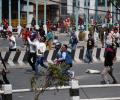
Nepal police used tear gas and water cannons to disperse pro-monarchy demonstrators who torched a house and tried to break security barricades in Kathmandu. The protesters chanted slogans demanding the restoration of the monarchy in Nepal. One person was injured in the clash.

As Nepal's Prime Minister Baburam Bhattarai prepares to undertake his maiden visit to India, his party -- the Unified Communist Party of Nepal-Maoist -- asks him not to sign a treaty with New Delhi and avoid discussing controversial issues. So is this visit simply a goodwill call or will Bhattarai defy his party. Shubha Singh analyses

Nepal's Unified Communist Party of Nepal-Maoist on Thursday demanded a suspension of the vote counting, alleging conspiracy after initial results showed the party trailing at third position in the constituent assembly elections.

A day after premier K P Oli resigned, Nepal President called on all the political parties to elect a new prime minister within a week

The JSP has made an electoral alliance with main opposition Communist Party of Nepal-Unified Marxist Leninist headed by K P Sharma Oli.

Prachanda took the oath of office and secrecy from President Bhandari at an official ceremony at Shital Niwas.

Bhattarai said his party 'Naya Shakti Nepal' would bear the "historic responsibility" of making Nepal prosperous and developed.
Three Madhesi leaders have supported Prachanda's candidacy.

Maoist chief Prachanda was on Wednesday elected by lawmakers as Nepal's Prime Minister for a second time.
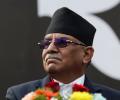
In a dramatic turn of events, Communist Party of Nepal-Maoist Centre chairman Pushpa Kamal Dahal 'Prachanda' was appointed as the new prime minister of Nepal by President Bidya Devi Bhandari on Sunday.

Amid chants of Buddhist scriptures, Nepal PM K P Sharma Oli on Monday offered prayers at an ancient temple in Kathmandu to mark the reconstruction of five heritage sites demolished by last year's deadly earthquake.

Nepal witnessed political turbulence in 2022 that dramatically turned rivals into allies and throned former guerrilla leader Pushpa Kamal Dahal 'Prachanda' as the prime minister for a third time, as Kathmandu made efforts to balance ties with immediate neighbours India and China with high-profile talks and visits.

K P Sharma Oli was elected as the next prime minister of Nepal on Sunday defeating incumbent Sushil Koirala in a contest which became necessary after parties failed to forge a consensus amid violent protests over the country's new Constitution.

The 75-year-old veteran politician and Nepali Congress President took the oath of office and secrecy from President Bidya Devi Bhandari during a swearing-in ceremony which was delayed by over two hours.

Postponing elections could lead to the collapse of the interim election government without an alternative arrangement, reports Shubha Singh

'Neither State should take the matter into a terrain that involves tension -- and certainly not war.'

Jaya Puri Gharti, who served as a cabinet minister during the Maoists' term in government, tells Patrick Ward about the issues facing Nepal and the difficult road to reconciliation.
 © 2026 Rediff.com - Advertise with us - Disclaimer - Privacy Policy - Sitemap - Feedback - About us - Terms of use - Grievances